
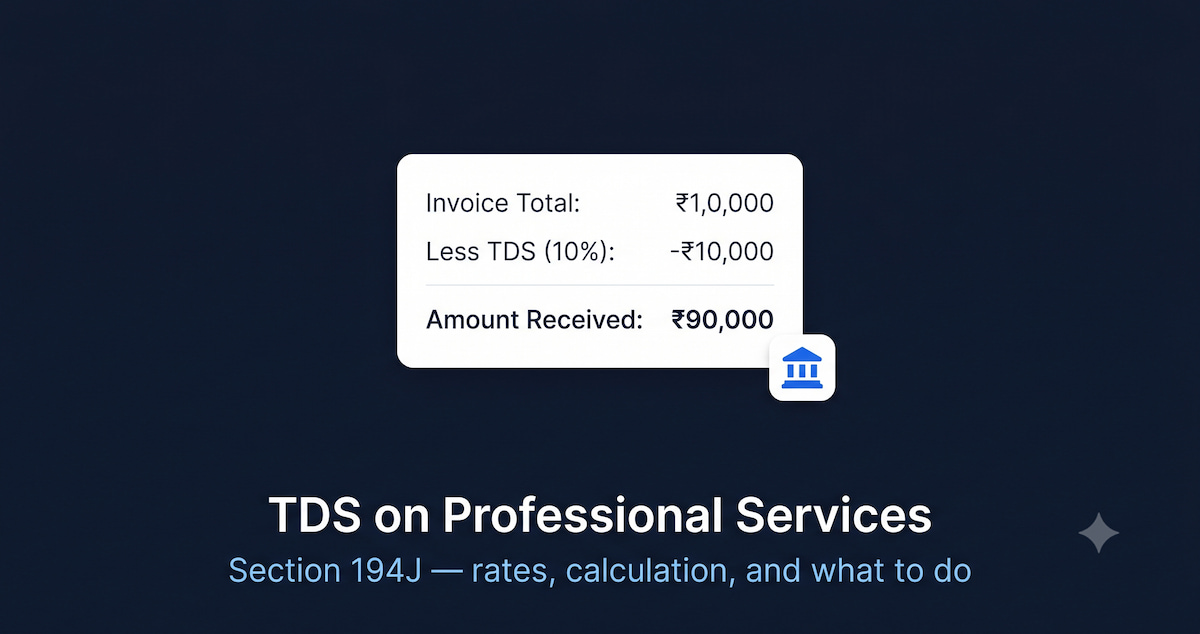
TDS — Tax Deducted at Source — is one of the most common sources of confusion for freelancers, consultants, and small businesses in India. If a client has ever paid you less than your invoice amount and said “we’ve deducted TDS,” this guide explains exactly what happened and how to handle it.
What Is TDS on Professional Services?
Under Section 194J of the Income Tax Act, any person (other than an individual or HUF not subject to tax audit) making a payment for professional or technical services must deduct TDS before paying the service provider.
This means the client deducts a percentage of your fee and deposits it with the government on your behalf. You receive the balance. The deducted amount is a credit against your income tax liability — you’re not losing money, you’re prepaying tax.
Who Has to Deduct TDS Under Section 194J?
TDS must be deducted by:
- Companies (private limited, public limited)
- Partnership firms
- LLPs
- Individuals and HUFs who are subject to tax audit (i.e., their business turnover exceeds the tax audit threshold)
Individuals and HUFs not subject to tax audit do not deduct TDS — so if a small individual client pays you, they typically don’t deduct TDS.
What Counts as “Professional Services”?
Section 194J covers fees for:
- Legal services (advocates, lawyers)
- Medical services (doctors, hospitals)
- Engineering and architectural services
- Accountancy and chartered accountancy services
- Technical consultancy
- Advertising agencies and film production
- Any profession notified by the CBDT
Technical services under 194J include:
- IT services and software development
- Management consulting
- Business process outsourcing (BPO)
- Any managerial or technical service not covered elsewhere
TDS Rate Under Section 194J
| Type of Payment | TDS Rate |
|---|---|
| Fees for professional services | 10% |
| Fees for technical services | 2% |
| Royalty (for certain film/song rights) | 2% |
| Non-compete fees | 10% |
| Director’s fees (not salary) | 10% |
Important: From FY 2020-21 onwards, the rate for technical services was reduced from 10% to 2%. This is a common source of errors — many businesses still deduct 10% on technical fees.
When Is TDS Deducted?
TDS must be deducted at the earlier of:
- When the payment is credited to the payee’s account, or
- When the payment is actually made
In practice, this means TDS is deducted when the payment is processed, not when the invoice is raised.
Threshold: TDS under 194J is only applicable when the total payment to a single person exceeds ₹30,000 in a financial year. Below this threshold, no TDS is deducted.
How to Calculate TDS on a Professional Invoice
Example 1: Professional Services (10% Rate)
A company engages a Chartered Accountant for audit services. Invoice amount: ₹1,00,000 + 18% GST.
| Item | Amount |
|---|---|
| Professional fee | ₹1,00,000 |
| GST @ 18% | ₹18,000 |
| Invoice Total | ₹1,18,000 |
| TDS @ 10% on ₹1,00,000 | ₹10,000 |
| Amount Paid by Client | ₹1,08,000 |
Key point: TDS is calculated on the base fee, not on the GST amount. GST is not included in the TDS calculation.
Example 2: Technical Services (2% Rate)
A company engages a software developer for a project. Invoice: ₹2,50,000 + 18% GST.
| Item | Amount |
|---|---|
| Technical fee | ₹2,50,000 |
| GST @ 18% | ₹45,000 |
| Invoice Total | ₹2,95,000 |
| TDS @ 2% on ₹2,50,000 | ₹5,000 |
| Amount Paid by Client | ₹2,90,000 |
What Does the Service Provider Do With TDS?
If a client deducts TDS from your payment:
- Collect Form 16A — your client must issue this TDS certificate quarterly. It shows how much TDS was deducted and deposited with the government.
- Verify in Form 26AS — log in to the income tax portal and check Form 26AS (or AIS). The TDS deducted should appear here once the client files their TDS return.
- Claim it while filing ITR — the TDS amount shows as a credit against your total tax liability. If your actual tax liability is less than the TDS deducted, you get a refund.
If the TDS doesn’t appear in Form 26AS, it means the client hasn’t deposited it — follow up with them immediately. You cannot claim credit for TDS that hasn’t been deposited.
Common Mistakes Around TDS
Deducting TDS on the GST portion. A very common error. TDS applies only on the base fee, not on the GST component.
Applying 10% instead of 2% on technical services. Check whether your service is “professional” or “technical” — the rates differ significantly.
Not issuing Form 16A on time. Clients must issue Form 16A within 15 days of the TDS return due date. Delay can cause issues for the service provider.
Deducting TDS below the ₹30,000 threshold. If annual payments to a vendor are below ₹30,000, TDS is not applicable.
Incorrect PAN. If the service provider doesn’t provide their PAN, TDS is deducted at 20%. Always share your PAN with clients upfront.
TDS Deposit and Return Due Dates
| Quarter | Period | TDS Return Due Date |
|---|---|---|
| Q1 | April–June | 31 July |
| Q2 | July–September | 31 October |
| Q3 | October–December | 31 January |
| Q4 | January–March | 31 May |
TDS must be deposited with the government by the 7th of the following month (except March, where the deadline is 30 April).
Handling TDS on Your Invoice and Receipt
When a client deducts TDS, your payment receipt should reflect the actual amount received — not the invoice total. For example, if your invoice was ₹1,00,000 and ₹10,000 TDS was deducted, the receipt acknowledges ₹90,000 received, with a line showing “Less: TDS @ 10% — ₹10,000.”
This keeps your books clean and gives the client a proper paper trail for their TDS records.
This article is for general information purposes. For advice specific to your situation, consult a Chartered Accountant.