
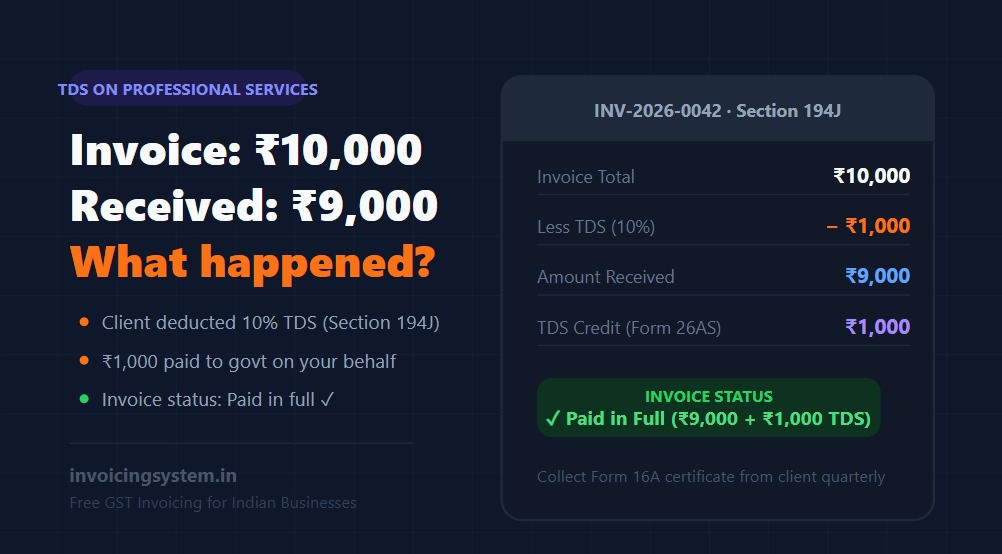
You send an invoice for ₹10,000. Your client pays ₹9,000. No explanation, no dispute — just short by 10%. Sound familiar?
That shortfall is almost certainly TDS — Tax Deducted at Source. And if you’re recording it as a partial payment or chasing the client for the balance, you’re handling it wrong.
Here’s what TDS actually is, why clients deduct it, and how to record it correctly in your books.
What is TDS?
TDS stands for Tax Deducted at Source. Under the Income Tax Act, certain businesses are required to deduct a percentage of payment before releasing it to the vendor — and deposit that amount directly with the government on your behalf.
It’s essentially advance tax collection. You get credit for the deducted amount when you file your income tax return. The TDS your clients deduct doesn’t disappear — it’s sitting in your Form 26AS as tax already paid.
Which Section Applies to Professional Services?
| Section | Applies To | TDS Rate | Threshold |
|---|---|---|---|
| 194J | Professional fees (doctors, lawyers, CAs, consultants, designers, developers, architects) | 10% | ₹30,000 per year per vendor |
| 194J (Technical) | Technical services (IT, engineering, data processing) | 2% | ₹30,000 per year per vendor |
| 194C | Contractors and sub-contractors | 1% (individual) / 2% (company) | ₹30,000 single / ₹1,00,000 annual |
| 194H | Commission or brokerage | 5% | ₹15,000 per year |
Most freelancers and agencies fall under Section 194J. If you provide IT or technical services, check whether the 2% technical services rate applies — many large corporate clients apply this instead of the standard 10%.
Who Deducts TDS — and Who Doesn’t?
Not every client deducts TDS. The obligation applies to:
- Companies (private limited, public limited)
- LLPs
- Partnership firms (in some cases)
- Government departments
- Individuals and HUFs whose books are subject to audit
Individual clients, small proprietorships, and startups below the audit threshold typically do not deduct TDS. If your client is a mid-size or large company, expect TDS deduction.
Does TDS Apply to GST Amount?
No. TDS under Income Tax is calculated on the base amount only — not on the GST component.
If your invoice is ₹10,000 + 18% GST = ₹11,800 total:
- TDS at 10% is calculated on ₹10,000 = ₹1,000
- Client pays: ₹11,800 − ₹1,000 = ₹10,800
This is separate from TDS under GST (Section 51 of CGST Act), which applies only to government bodies and notified entities — most private businesses are not affected by GST-TDS.
The Problem: Most Invoicing Tools Can’t Handle TDS
Standard invoicing software has a binary toggle: Paid or Unpaid. That’s it.
This creates a real problem. Your invoice is for ₹10,000. You receive ₹9,000. You can’t mark it as “Paid” because the amounts don’t match. You can’t mark it as “Unpaid” because you did receive money. So it sits in limbo — your books show outstanding receivables that have actually been settled.
The correct way to record TDS deduction is:
- Record the full invoice amount as income: ₹10,000
- Record TDS deducted as advance tax paid: ₹1,000
- Record amount actually received in bank: ₹9,000
- Status: Paid in full (₹9,000 cash + ₹1,000 TDS = ₹10,000)
The invoice is settled — just not entirely in cash.
The TDS Certificate: Form 16A
Your client must issue you a Form 16A certificate for TDS deducted — quarterly. This certificate shows:
- The amount deducted
- The section under which it was deducted
- The challan details of the deposit to the government
Always collect Form 16A from clients who deduct TDS. Your CA will need it at tax filing time. If the TDS is not reflected in your Form 26AS, it means your client hasn’t deposited it — which is their compliance failure, not yours, but you’ll need to follow up.
What to Do If Your Client Deducts the Wrong Rate
If a client deducts 10% when the correct rate is 2% (for technical services), you can:
- Provide a declaration clarifying the nature of services
- Claim the excess TDS credit when filing your ITR
- Request a refund from the Income Tax Department if the excess results in a net refund
In practice, most businesses accept the higher deduction and adjust at ITR filing time rather than getting into a discussion with every client.
Key Takeaways
- TDS is advance tax — not a loss. It’s credited to you when you file your ITR.
- TDS is deducted on the base amount, not on GST.
- The standard rate for professional fees is 10% (Section 194J). Technical services may attract 2%.
- Always collect Form 16A certificates — quarterly, not annually.
- Your invoicing records should reflect the full invoice value as income and the TDS as tax paid, not as a shortfall.
Invoicing System lets you record exactly what you received — including TDS deducted and payment mode — so your invoice shows as settled even when the client pays less than the full amount. No more “unpaid” invoices that were actually paid minus TDS. Try it free →