
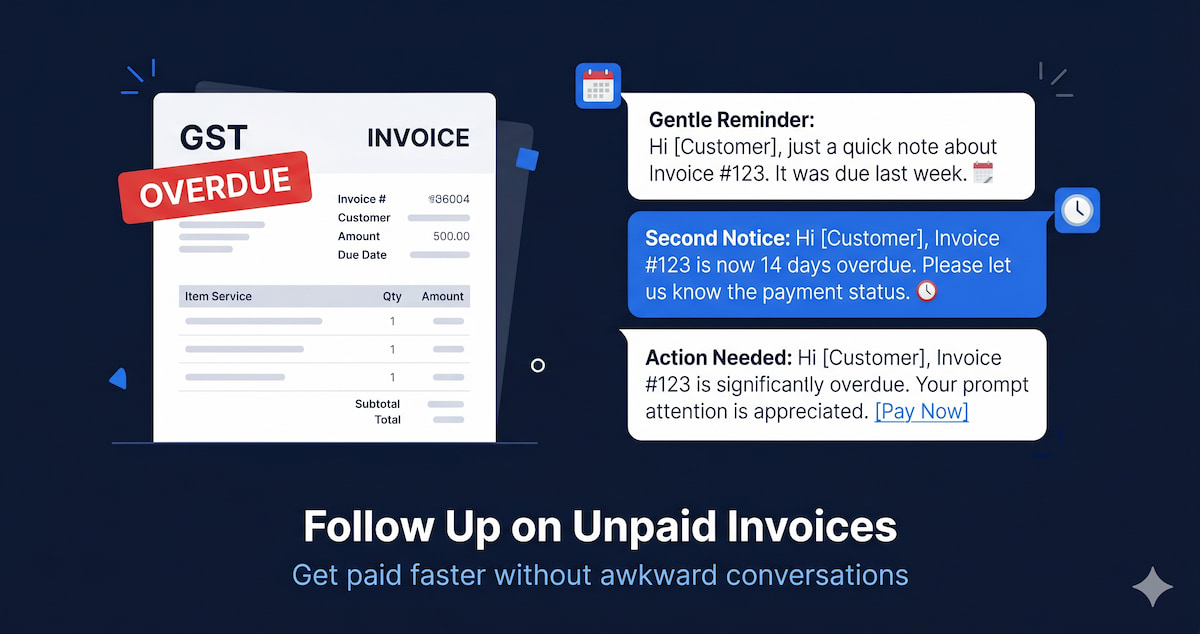
Late payments are one of the biggest cash flow problems for Indian SMEs. You’ve done the work, raised the invoice, and now — silence. Following up feels awkward, but not following up costs you money.
The good news: a structured, professional follow-up process gets results without burning relationships.
Why Most Businesses Don’t Follow Up (And Why They Should)
Most business owners avoid chasing payments because they:
- Don’t want to seem desperate
- Worry about damaging the client relationship
- Simply forget
Here’s the reality: clients have dozens of invoices landing in their inbox every month. Yours gets delayed not because they don’t want to pay — but because no one nudged them. A professional follow-up isn’t aggressive. It’s expected.
The 4-Stage Follow-Up Sequence
Use this sequence for every unpaid invoice. Adjust the tone based on your relationship with the client.
Stage 1: Payment Reminder (3–5 Days Before Due Date)
Send a gentle heads-up before the invoice is even overdue. This sets expectations and gives finance teams time to process.
Subject: Payment Reminder — Invoice [Number] Due on [Date]
Hi [Name],
Just a friendly reminder that Invoice [Number] for ₹[Amount] is due on [Date].
If you need a copy of the invoice or have any questions, feel free to reach out.
Thank you!
Keep it short. No pressure. Just a nudge.
Stage 2: First Overdue Notice (1–3 Days After Due Date)
The due date has passed. Tone stays professional but shifts to action.
Subject: Invoice [Number] — Payment Due
Hi [Name],
Invoice [Number] for ₹[Amount] was due on [Date] and appears to still be outstanding.
Please let us know if there’s anything blocking payment or if you need any documentation from our end.
Payment details are on the invoice. Link: [Share Link]
Stage 3: Second Follow-Up (7–10 Days Overdue)
More direct. Ask for a specific date.
Subject: Following Up — Invoice [Number] Overdue
Hi [Name],
We’re following up on Invoice [Number] for ₹[Amount], now [X] days overdue.
Could you let us know when we can expect payment? If there’s a dispute or issue, we’re happy to resolve it quickly.
At this stage, CC the accounts person if you know who they are.
Stage 4: Final Notice (15–30 Days Overdue)
Firm, factual, no anger. Put them on notice.
Subject: Final Notice — Invoice [Number] Overdue by [X] Days
Hi [Name],
Despite previous reminders, Invoice [Number] for ₹[Amount] remains unpaid.
We request immediate payment within 7 days. If we don’t hear from you, we’ll need to escalate this internally.
Please treat this as urgent.
Tips That Actually Work
Send invoices with a direct payment link. The harder it is to act on an invoice, the slower you get paid. Invoices with a shareable link and clear bank details get processed faster.
WhatsApp works. In India, a WhatsApp message gets noticed faster than an email. A short, professional message — “Hi [Name], just sending across Invoice [Number] for ₹[Amount]. Please let us know if you need anything.” — is completely acceptable for most B2B relationships.
Follow up in the morning. Finance teams process payments in the first half of the day. An email at 9–10 AM gets more attention than one sent at 5 PM.
Don’t apologise for chasing. “Sorry to bother you” weakens your position. You’re owed money. Be polite, not apologetic.
Document every follow-up. If a dispute goes further, you’ll need a clear timeline of what you sent and when.
What to Do When Nothing Works
If payment is still outstanding after 30 days and the client is unresponsive:
- Call directly — speak to the decision-maker, not just the accounts team
- Send a formal demand letter on letterhead
- Consider a legal notice if the amount justifies it
- For recurring clients, pause work until payment is received
Most disputes resolve before you get to this stage. The key is not letting invoices sit silently for weeks before acting.
Automate Your Follow-Ups
Manually tracking which invoices need a follow-up, on which date, and what stage you’re at — is a time sink. One missed follow-up can add weeks to your payment cycle.
Invoicing System Pro (coming soon) will automate this entire sequence — sending reminders at 7, 15, and 30 days automatically via email and WhatsApp, so you never have to think about it. Get early access →
Managing invoices for your Indian business? Invoicing System is a free GST invoicing platform built for Indian SMEs — create, share, and track invoices in minutes.